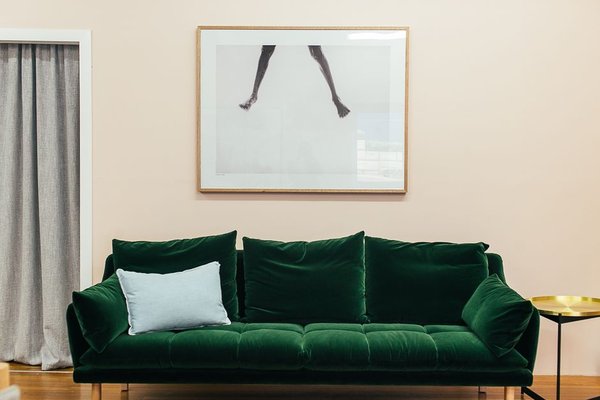
Wall art above a sofa looks right when it feels connected to the furniture rather than floating independently on the wall. The simplest way to achieve that is to judge two measurements together: the width of the artwork compared with the sofa, and the gap between the sofa back and the bottom of the frame. Get those proportions right and even a simple print can look deliberate and properly scaled.
For most living rooms, a useful starting point is to make the total artwork width roughly two-thirds to three-quarters of the sofa width. From there, adjust the hanging height for the sofa back, frame depth and room proportions.
How wide should wall art be above a sofa?
Measure the sofa from arm to arm, then multiply that width by about 0.67 to 0.75. The result gives you a practical target range for the total visible width of the art. A picture that is much narrower can look undersized, while one that is almost as wide as the sofa can make the wall feel top-heavy.
For example, if your sofa is 180 cm wide, aim for artwork approximately 120 to 135 cm wide. If the sofa is 210 cm wide, a total artwork width of roughly 140 to 158 cm usually gives a more convincing proportion. You do not have to hit the number exactly; the ratio is a guide for choosing between realistic frame sizes.
Typical size for a two-seater sofa
Many two-seater sofas are around 150 to 180 cm wide. Using the two-thirds to three-quarters guideline, a single large piece or the combined width of a pair could sit around 100 to 135 cm. Measure the actual sofa rather than relying only on the “two-seater” label, because arm widths vary considerably.
Typical size for a three-seater sofa
A three-seater often measures around 190 to 230 cm wide, depending on its design. That makes an artwork span of roughly 130 to 170 cm a useful planning range. Wide arms can add more to the sofa’s overall width than expected, so use the full arm-to-arm measurement.
How high to hang art above a sofa
When deciding how high to hang art over furniture, the sofa is the key reference point. In most rooms, leave roughly 15 to 25 cm between the top of the sofa and the bottom edge of the frame. This keeps the piece visually tied to the seating area without making it look cramped.
The best art above sofa height is often lower than people first expect. A common mistake is to position a picture according to the empty wall or ceiling rather than the furniture underneath it. If the frame seems to belong to the upper half of the wall instead of the sofa arrangement, bring it down and reassess from across the room.
For a high-backed sofa, use the smaller end of the gap range so the artwork does not creep too close to the ceiling. With a low-profile sofa and a tall wall, a slightly larger gap can work, but the art should still read as part of the same composition.
Single artwork versus two matching prints
The width rule applies to the complete artwork area, not just to each individual frame. If you are hanging two prints, add the frame widths and the gap between them. Their combined span should still sit comfortably within the two-thirds to three-quarters range.
Suppose a 200 cm sofa needs an artwork span of roughly 134 to 150 cm. Two 62 cm frames with an 8 cm gap create a total span of 132 cm, which is close to the target. Two 45 cm frames with the same gap create only 98 cm, so they may look too small even if each print works well on its own.
For paired pieces, a gap of around 5 to 10 cm often feels cohesive. Much wider spacing can make the frames read as separate decorations rather than one balanced display.
Why the frame size matters
When comparing picture size for living room walls, check the outer frame dimensions rather than the printed image alone. A generous mount and thick frame can add several centimetres to each side, changing the final proportion considerably.
This can help when you already own a print that feels slightly too small. Reframing it with a wider mount may increase its visual footprint without replacing the artwork. Likewise, a heavy frame can make a piece feel larger and more dominant than the print dimensions suggest.
A simple measuring method before you drill
Use painter’s tape or low-tack masking tape to mark the proposed outer dimensions directly on the wall. Calculate the target artwork span, tape a rectangle centred over the sofa, and place its bottom edge about 15 to 25 cm above the sofa back.
Then step across the room and look at the outline from the doorway and your usual seating position. If it feels narrow, test the upper end of the width range. If it feels heavy, reduce the width slightly before changing the height. This mock-up is more reliable than trying to judge a frame while holding it against the wall.
What if the sofa is not centred on the wall?
Base the artwork position on the sofa rather than automatically centring it on the wall. If the sofa sits off-centre because of a doorway, fireplace or side table, artwork centred on the wall can look disconnected from the furniture. Centring the frame or pair over the sofa usually creates the stronger visual relationship.
FAQ
Should wall art be wider than the sofa?
Usually, no. Artwork that extends beyond the sofa arms can overpower the furniture. Keeping the total art width around two-thirds to three-quarters of the sofa width is a safer starting point.
How much space should be between a sofa and wall art?
A gap of roughly 15 to 25 cm from the top of the sofa to the bottom of the frame works well in many rooms. Use the smaller end for a high-backed sofa and adjust slightly for the room’s scale.
Is one large picture better than two smaller pictures?
Neither is automatically better. One large picture creates a simple focal point, while two coordinated prints can achieve similar visual weight if their combined width and spacing are proportionate to the sofa.
Do I measure the print or the frame?
Use the full outer dimensions of the frame because that is the size the eye reads on the wall. If you are using two pieces, include the gap between them when calculating the total span.
Getting the proportion right
The most dependable way to choose wall art size above a sofa is to measure rather than guess. Start with artwork around two-thirds to three-quarters of the sofa width, keep the bottom edge roughly 15 to 25 cm above the sofa, and judge the complete framed dimensions. Those two relationships—width and height—do most of the visual work and help the artwork feel intentionally connected to the room.