
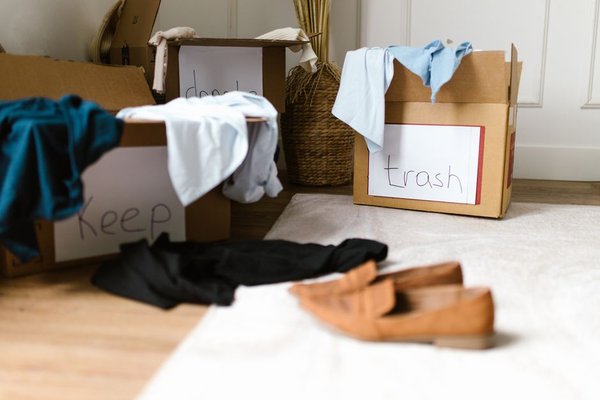
The hardest part of decluttering often comes after the clear-out. You have finally made room in the wardrobe, cleared the kitchen counter and found homes for the things you use. Then a few shopping trips, gifts and everyday purchases quietly fill the gaps again. The one in one out decluttering method tackles that second problem: keeping clutter from returning.
Its appeal is simplicity. Rather than planning another major purge every few months, you make a small decision whenever something new enters your home. It is a maintenance habit, not a demand to own as little as possible.
What Does One-In, One-Out Actually Mean?
The one in one out rule means that when you bring one item into a particular category, you remove one existing item from that same category. Buy a new mug? Choose a mug to donate, give away or recycle responsibly. Replace a worn pair of trainers? Let the old pair go instead of keeping it indefinitely as a spare.
Matching categories matters. Getting rid of an old receipt does not offset buying a coat. The purpose is to keep a category from expanding beyond the space you have allocated to it, not to earn permission to shop by discarding something unrelated.
“Out” means the item genuinely leaves your possession or moves into a clearly defined donation or recycling process. Shifting it from the kitchen cupboard into a garage box simply relocates the clutter.
Why This Method Works Best After a Bigger Clear-Out
One-in, one-out is a form of clutter prevention. It can help maintain a comfortable number of belongings, but it will not necessarily reduce an already overflowing collection. If you have forty T-shirts and room for twenty, swapping one for one keeps you at forty.
Start with a realistic reset. Sort the problem area, remove what you no longer need and decide how much space the category can occupy. A wardrobe edit or a practical kitchen decluttering checklist can help you establish that baseline. Then use one-in, one-out to protect the progress.
How to Start Without Turning It Into a Chore
Choose two or three categories first
Begin with belongings that arrive regularly and are easy to compare: clothes, shoes, mugs, handbags, toys or decorative cushions. Applying the rule to absolutely everything from day one can make an otherwise useful habit exhausting.
Pick one category that tends to grow, set a sensible boundary and explain the rule to anyone who shares that storage space. The aim is cooperation rather than policing each other’s possessions.
Decide what counts as a replacement
A replacement does not have to be identical. A new everyday jacket might replace a coat that no longer fits your needs. However, removing a raincoat to make room for a winter coat could leave you without something essential. Think about function as well as numbers.
Consumables such as toothpaste and washing-up liquid generally do not need this rule because they are used up. Important documents, safety equipment and sentimental keepsakes deserve separate decisions rather than automatic disposal.
Make leaving the house part of the routine
Keep a small donation bag somewhere convenient, but give it a deadline. Check that donated items are clean, usable and accepted by the organisation. Recycle broken products through appropriate local facilities; do not donate unusable items just to satisfy the rule.
Everyday Examples That Show the Rule in Action
A wardrobe with no spare hangers
Imagine you have finished decluttering a bedroom wardrobe and every item now has a hanger or folded space. You buy a new shirt on Saturday. Before putting it away, look through your shirts and choose one that is uncomfortable, rarely worn or no longer your style. The new shirt takes its place rather than requiring an extra hanger.
If you cannot identify a shirt to release, that is useful information. You could postpone the purchase, return the new shirt if appropriate or deliberately reassess the space limit. The rule works as a decision aid, not an automatic punishment.
Children’s toys and shared spaces
For toys, involve children in choosing an outgrown item before a new one arrives. Avoid forcing immediate decisions about favourite comfort objects. A toy rotation system may work better for younger children, while a regular family review can handle birthdays and holiday gifts.
Know When One-In, One-Out Is the Wrong Tool
Not every new purchase should trigger a disposal. A household setting up its first kitchen needs to build a collection. Seasonal changes, a new hobby, a growing child’s changing needs or a shift in mobility can also require additional belongings.
Similarly, do not throw away a functional item solely to justify buying another. That turns a useful minimalist organisation method into unnecessary waste. Shopping less, buying second-hand and repairing what you have can be more sensible than following the numbers rigidly.
Small Habits That Make the Rule Last
Good decluttering habits depend on making the next action easy. Keep the return window or receipt in mind, identify an outgoing item before shopping when possible and schedule a weekly moment to move the donation bag out of your home.
Use physical space as your guide: one shoe rack, one shelf for mugs or one basket for spare blankets. A fixed boundary is often clearer than a complicated inventory. If the space stays usable, the system is doing its job.
If clutter has already spread beyond those boundaries, revisit a room-by-room decluttering plan or simple storage organisation ideas before trying to maintain the result. One-in, one-out is most effective when it supports a home that already works for you.
Frequently Asked Questions
Does one-in, one-out mean throwing something away every time I shop?
No. It applies to belongings that accumulate, especially within a chosen category. An outgoing item can be sold, donated, gifted or recycled appropriately. Ordinary groceries and consumables do not generally need a matching item removed.
Can I use the method if I am not a minimalist?
Absolutely. You do not need a minimalist home or a specific item count. The rule simply helps you maintain the amount of clothing, cookware or other belongings that suits your life and storage space.
What if I receive several gifts at once?
Do not rush to remove treasured belongings. First decide which gifts you will genuinely use, then review the relevant category when you have time. It is reasonable to make exceptions, particularly for meaningful or hard-to-replace items.
Is one-in, one-out enough to declutter a messy home?
Usually not on its own. It mainly prevents categories from growing. If your rooms are already crowded, begin with a focused clear-out and follow it with one-in, one-out to maintain the space you create.
A Simple Rule for Keeping the Space You Have Gained
The one in one out decluttering method succeeds when it feels like a natural part of choosing what belongs in your home. Start with a single problem category, make fair exchanges and allow practical exceptions. You are not chasing a perfect number of possessions; you are preventing yesterday’s hard-won space from disappearing again.