
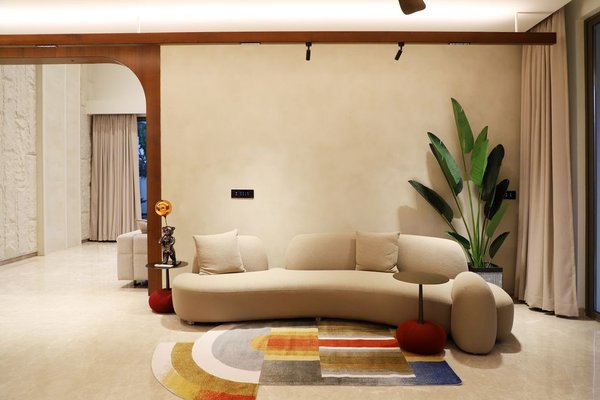
The curved sofa living room trend has moved beyond glossy showrooms and into real British homes. In 2026, its appeal is less about novelty and more about what the shape does for a room: it softens hard architectural lines, makes seating feel more sociable and gives an ordinary layout a clear visual centre. A curved sofa can look sculptural without becoming cold or impractical, provided its size, fabric and position suit the way the room is actually used.
Why Curved Sofas Feel Right for 2026
Living rooms are becoming softer, more layered and less dependent on matching furniture sets. Curves fit naturally into that shift. They can also support conversation because the seating subtly turns people towards one another rather than placing everyone in a straight line.
Curved sofas are available in compact two-seaters, modular formats and gently bowed designs, not only dramatic crescents made for large open-plan homes. That makes the look realistic for UK terraces, semi-detached houses and flats.
Choose a Curve That Matches the Room
Not every curved sofa needs to be theatrical. A shallow arc is often easier to place than a deep semicircle, especially in a narrow living room. Before buying, mark the sofa’s full footprint on the floor with masking tape. Include the deepest point of the curve, not just the stated width, and check that doors, radiators and main walkways remain clear.
For compact living rooms
Look for a gently curved front, rounded arms or a small kidney-shaped two-seater. Raised legs can keep more floor visible, helping the room feel less crowded. Avoid surrounding it with heavy side tables or bulky storage.
For larger spaces
A deeper curve can work as a living room centrepiece and define the seating zone without building a divider. Floating the sofa away from the wall lets its silhouette be seen properly and can create a soft boundary between lounge and dining areas.
Plan the Layout Around Movement
The best curved sofa styling begins with circulation. People should be able to enter, cross and leave the room without squeezing around the sofa’s widest point. In many rooms, the curve works best facing the main focal area while leaving a clear route behind or beside it.
A round or oval coffee table is usually easier to pair with a curved sofa than a sharp rectangular one. It echoes the shape while reducing awkward corners in the gap between seat and table. An irregular stone, timber or glass design can make the arrangement feel collected rather than staged.
Avoid placing every other item in a matching arc. One or two rounded companions are enough. A straight-lined media unit, slim console or angular side chair adds contrast and prevents the room from feeling overly themed.
Use Colour and Texture to Control the Impact
Because the silhouette already attracts attention, the upholstery can be quiet or bold. Cream, oatmeal, mushroom and warm grey make the form feel calm and architectural. Olive, rust, deep blue or chocolate brown create a stronger focal point. In a busy family home, a mid-tone woven fabric is often more forgiving than bright white bouclé.
Chenille, velvet and softly napped performance fabrics emphasise depth without needing pattern. Check cleaning instructions, abrasion ratings and whether cushion covers are removable.
For balanced statement sofa ideas, repeat one upholstery colour elsewhere in a smaller dose, perhaps through artwork, a lampshade or a single cushion. Do not cover the entire back with cushions; leaving sections visible allows the curve itself to remain the feature.
Build a Supporting Scheme
A curved sofa looks strongest when the rest of the room supports its proportions. Choose a rug large enough to connect the seating area, ideally with the sofa’s front edge resting on it. A rectangular rug creates grounding contrast, while an oval rug reinforces the softer mood.
Lighting should add height and direction. An arched floor lamp can follow the furniture’s movement, but a globe lamp or sculptural table lamp may be subtler. Layer overhead, wall and low-level lighting so the sofa does not sit in a flat pool of ceiling light.
A Practical UK Living Room Example
Imagine a rectangular Victorian terrace living room with a bay window and a fireplace on one side wall. Instead of forcing a curved sofa against the longest wall, position a compact shallow-arc model slightly forward and angled towards the fireplace. Place an oval coffee table in front, then add one straight-backed accent chair near the bay window. A slim console behind the sofa can provide a lamp and storage while keeping the route from the doorway clear.
This arrangement improves conversation and softens strong architectural lines without sacrificing access.
Common Styling Mistakes to Avoid
Buying by width alone
Curved furniture can project farther into a room than a standard sofa. Check maximum depth, delivery access and turning space through hallways and doors.
Placing it tightly against a wall
A small gap often looks more intentional and prevents the curve from appearing cramped. Even 15 to 25 centimetres can help where space allows.
Adding too many rounded pieces
Repeating curves everywhere weakens the sofa’s impact. Mix organic forms with clean, straight elements to create structure.
Choosing appearance over comfort
Low backs and deep seats can look elegant but may not suit everyone. Test the seat height, back support and lounging position before committing.
Related Ideas to Explore
For a wider scheme, explore warm neutral living room ideas, choosing the right living room rug and styling statement furniture in small spaces.
Frequently Asked Questions
Are curved sofas still in style in 2026?
Yes. Curved and sculptural seating remains a visible 2026 direction, but its longevity depends on choosing a comfortable, well-proportioned design rather than the most exaggerated silhouette available.
Can a curved sofa work in a small living room?
It can, especially when the curve is shallow and the footprint is compact. Measure the maximum depth, preserve a clear walkway and avoid bulky furniture around it.
What coffee table works with a curved sofa?
Round, oval and softly irregular tables usually fit the inner curve well. A rectangular table can also work when it is narrow enough to maintain comfortable clearance.
Should a curved sofa sit against the wall?
It may sit near a wall in a smaller room, but leaving a small gap often shows the shape more clearly. In a larger space, floating it can improve zoning and conversation.
A Softer Statement That Still Works Hard
The curved sofa living room trend succeeds when shape and function receive equal attention. Choose a curve that fits the floor plan, protect circulation, balance it with simpler furniture and select upholstery for real daily life. Styled this way, a curved sofa feels less like a passing showroom look and more like a confident, comfortable centrepiece that can anchor the room beyond 2026.